


Creatine Monohydrate
Creatine Monohydrate
For men over who feel a step removed from themselves.
One molecule. 5g daily. 30+ years of human research. The foundation supplement most men don't know they're missing.
Couldn't load pickup availability

Creatine Monohydrate
Description
Description
What it is, and what it isn't.
You've done the things. You train. You sleep when you can. You eat reasonably clean. And somewhere along the way the energy still dropped, the focus got shorter, and recovery started taking longer than it used to.
That's not weakness. That's biology — and there's a layer most men never address.
Every cell in your body runs on a molecule called ATP. Phosphocreatine is what helps you regenerate it. After 30, your stores of it quietly decline. Your bloodwork won't show this. Your gym won't tell you about it. But you feel it — in the afternoon crash, in the second cup of coffee, in the rep you used to get and now don't, in the workout that wrecks you for three days instead of one.
Creatine is the most-studied supplement in human nutrition. 500+ human trials. 30 years. One molecule. And it's still considered optional — which is why most men over 35 are running on a deficit they don't know exists.
What Creatine Does
Creatine doesn't spike anything. It doesn't stimulate. It doesn't replace coffee. It's not a pre-workout.
It works by topping up your phosphocreatine stores — the system your body already uses to power short bursts of effort, recover between sets, and keep your brain firing through a long workday. The effect builds quietly. Most men feel it around week 3: the afternoon crash softens, recovery between training sessions gets shorter, mental sharpness holds longer.
The research is unusually consistent for a supplement. The International Society of Sports Nutrition calls creatine "the most effective ergogenic nutritional supplement currently available." It's safe to take long-term. It's safe for men, women, and adults over 60. And it stacks under everything else you're doing — training, sleep, protein, the basics — without interfering with any of it.
It's not a transformation. It's a foundation.
Why QualiGreen
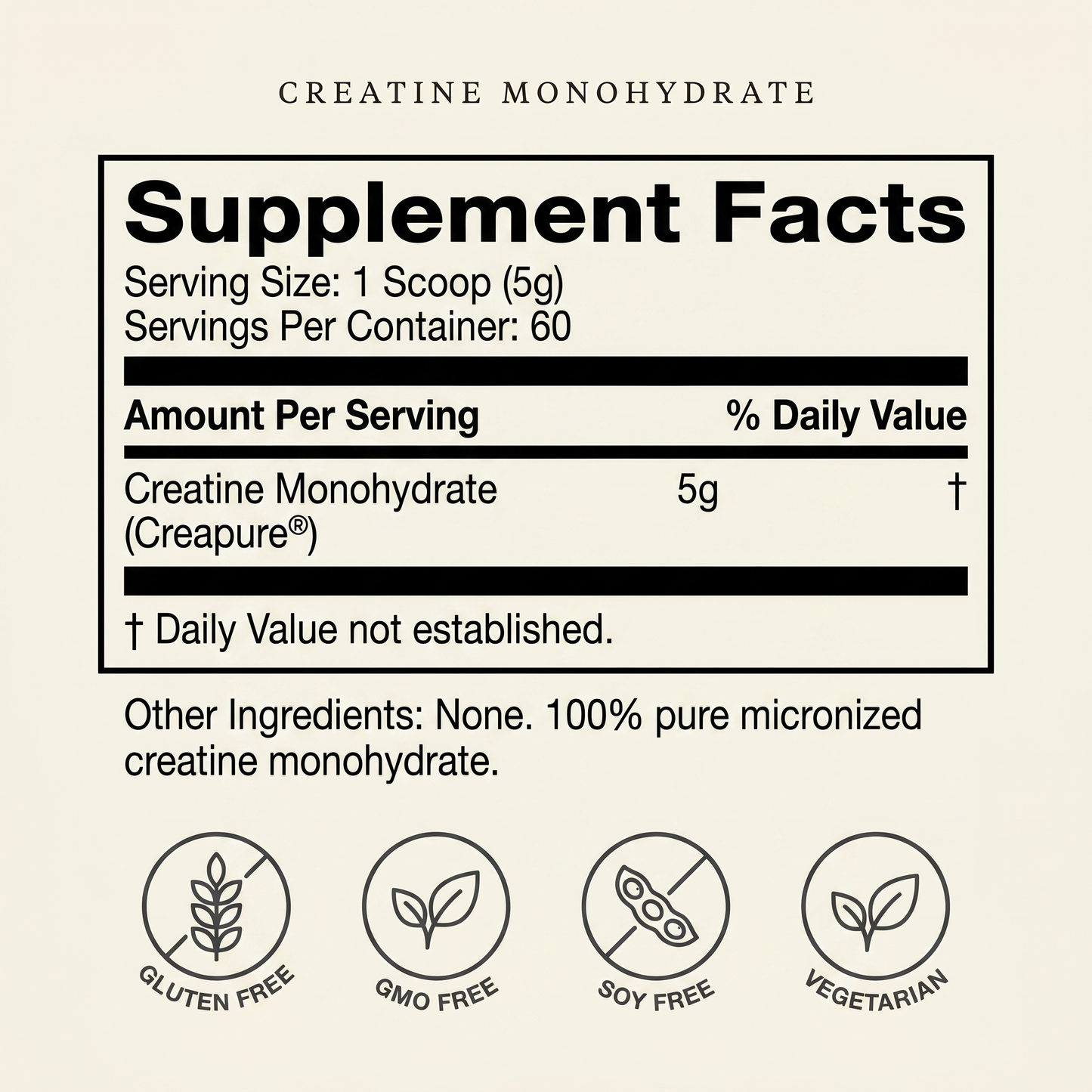
One ingredient. Creapure® creatine monohydrate, made in Germany, the same source the published clinical studies use. 5 g per scoop. Unflavored. In a sober tub with a third-party Certificate of Analysis available below.
No proprietary blends. No "creatine + nootropic" mix where the dose is hidden. No HMB padding. No flavoring that masks low purity. No gummies that independent testing keeps catching at near-zero active ingredient.
We didn't pay a podcaster. We sourced Creapure®. The difference shows up on the Certificate of Analysis, not in the influencer slot.
That's the whole product.
Why most men are skipping the one supplement that would help them most
Why most men are skipping the one supplement that would help them most
Creatine has a brand problem. For thirty years it's been marketed to college lifters and bodybuilders, in tubs with cartoon muscles and explosive sounding names. The men who would benefit most from it — the 38-to-55-year-old whose recovery has slowed and whose afternoons have flattened — have been told, implicitly, that this isn't for them.
It is. The research is overwhelming. And the brands made the wrong product for the wrong man for a generation. Here's what that costs you, and where we land.
There are hundreds of creatine tubs on Amazon between fifteen and thirty dollars. They're cheap because of where the brand cut. Here's where the category cuts — and where we don't.
Source.
Most creatine on Amazon is from undisclosed Chinese suppliers. Same molecule on paper, inconsistent purity in the tub. We use Creapure®, made by AlzChem in Germany — the source the published clinical research actually uses. It costs more. We pay it.
Dose.
5 g a day. That's the dose every major clinical trial has used since 1992. Less is sub-clinical. More gets flushed. Most "creatine +" blends hide the real creatine dose inside a proprietary mix, which usually means there's less in there than the front of the label suggests. QualiGreen is one scoop. 5 g. On the label, in the tub.
Format.
Gummies keep failing independent lab tests — many contain a fraction of the labeled dose. Capsules need 6–10 a day to hit 5 g; most men quit within a month. Unflavored powder in water or coffee is what the research uses and what consistent users actually stay on for years. Boring. It works.
Verification.
"Premium quality" is a marketing phrase, not a measurement. Every QualiGreen batch is third-party tested. The certificate of analysis is at the bottom of this page. In a category with this much hype, that should be table stakes — not a feature.
Ingredients
Ingredients
Creapure® Creatine Monohydrate
The most clinically-studied form of creatine, manufactured by AlzChem in Trostberg, Germany. Tested for purity (≥99.9%) and the absence of impurities like dicyandiamide and dihydrotriazine. Used in the majority of peer-reviewed creatine research since the 1990s.
Benefits
Benefits
Steadier daily energy
Phosphocreatine is what your cells use to keep ATP — your body's actual energy currency — available on demand. Topped-up stores mean less afternoon crash, less reaching for the third coffee, less running on fumes by 4 pm.
Faster training recovery
The 72-hour wreck after leg day becomes a 24-hour soreness. The 3-day-a-week gym schedule starts feeling sustainable again. Strength comes back not because you got younger, but because your body finally has what it needs to recover at the pace you actually want to train.
Sharper mental focus
Your brain is metabolically expensive — it uses roughly 20% of your total energy. Multiple studies suggest creatine supports cognitive performance, particularly under sleep deprivation, fatigue, or sustained mental effort. Clearer thinking through a long workday, without leaning on stimulants.
Long-term strength preservation
After 30, men lose roughly 1% of muscle mass per year. After 50, the rate accelerates. The research on creatine plus resistance training in adults over 50 is some of the strongest in the longevity literature — it doesn't reverse aging, but it changes the slope. The man at 70 who can still lift his grandkids is the man who started a foundation supplement at 45.
The basic stack, finally complete
Sleep, protein, training, sunlight, walking. Those are the basics. Creatine is the one supplement with thirty years of human trials behind it that belongs alongside them — not stacked on top, not optional, not for athletes only. It's the missing default.
No bloating. No water-weight panic. No loading phase required.
Older brands will tell you to "load" creatine — 20 g a day for a week. The research shows it's unnecessary; 5 g daily reaches the same saturation in 3–4 weeks. Skip the loading. Skip the stomach. Start with a clean 5 g and stay there.
90-Day Money-Back Guarantee
90-Day Money-Back Guarantee
We stand behind the quality of QualiGreen.
If you’re not fully satisfied within 90 days, simply reach out and we’ll refund your order — no questions asked.
Creatine works on a slower curve than stimulants. Most men feel it around weeks 3–4: steadier energy, faster recovery, a little more clarity in the afternoon. Some notice it sooner. A few notice it later. Take the 90 days. If your body says no, your money comes back. Risk nothing.




What 3,518+ Men Are Saying
-

Keeping the tub in the car so I actually take it
Tried this in a shake first month and kept forgetting. Now I keep the tub in the car and dump a scoop in my morning coffee at the office. Two months in: less brain fog, recovery from gym is faster, no jitters. The tub looks beat up because it lives in my truck. Worth it.
-

First scoop felt like nothing. Three weeks in, I noticed.
Bought this after my brother kept bugging me about creatine for guys our age. Felt nothing the first two weeks — figured I'd wasted $30. Then around week three I realized I hadn't hit the couch at 7pm in days. Wife said I seemed less wiped after work. That's it. No miracle, no transformation. Just stopped collapsing every night. Reordered.
-

At 50, I just wanted my knees back.
Worked construction my whole life. Knees were starting to go, recovery from a long day on a job site was taking until Wednesday. My son told me to try creatine. I told him that was for kids in the gym. He sent me an article. Tried it. Three months later I'm back to one-day recovery from a 10-hour shift. Stuff works. No fancy marketing, just works.
-

Mix it in coffee, taste nothing, done.
I'm not going to lie, I almost didn't order because I hate adding stuff to my morning. But unflavored really is unflavored — it dissolves in coffee and you don't taste a thing. Three months on it now. I'm 44, two kids, run a business. The wall I used to hit at 3pm is just gone. That's the whole review.
-

The afternoon crash was killing my work
Software engineer. 16 years at a desk. Used to push through 3pm with caffeine and willpower. Started this six weeks ago — afternoons are different now. Not energetic, just not crashed. Last week I worked through a 4-hour code review and only had one coffee. That hasn't happened in years.
-

Back to lifting heavy without the recovery hell
42, lifting since college, but the last few years recovery from heavy leg days was wrecking me for 3-4 days. Started this 8 weeks ago. Recovery is back to one day, sometimes less. I'm not stronger overnight, but I'm finally training the way I want to again instead of dragging through the next session. That's what I needed.
-

Sleep got deeper. Didn't expect that.
Started taking this for energy, not sleep. But somewhere in week 3 I noticed I was actually waking up rested. I'd been fighting low-grade insomnia for two years — tried magnesium, melatonin, the whole thing. Creatine wasn't supposed to do this and I have no idea if it's the real reason. But I'm sleeping. So I'm not stopping.
-

Replaced three supplements with this one
My wife noticed the medicine cabinet looked emptier and asked what I'd thrown out. Turns out I'd quietly stopped buying my pre-workout, my afternoon energy pills, and that adaptogen blend I'd convinced myself was doing something. Just creatine now. Cheaper, simpler, and I actually feel better than when I was stacking five things.


Every Year You Wait Is A Year You Don't Get Back
After 30, your muscle mass drops about 1% a year — and the cellular energy system that powers it drops with it. By 45, most men are operating on phosphocreatine stores that are noticeably lower than they were at 25. By 55, the gap gets harder to close.
That's not a sales pitch — that's published exercise physiology. Standard bloodwork doesn't measure any of it.
The energy, the recovery, the afternoon sharpness you've been missing aren't coming back on their own. They're maintained — by training, by sleep, by protein, and by the one supplement with three decades of human research behind it.
Creatine takes 3–4 weeks to reach full saturation. The men who keep their floor are the ones who started.
Start now. Your future self will thank you.
✓ 90-day money-back guarantee
✓ Free UPS shipping
✓ Third-party lab tested
What Our Customers Experience After 60 Days
Based on a survey of 900+ verified QualiGreen customers after 60 days of consistent use.
92%
Reported steadier energy through the afternoon — less crash, less reliance on caffeine.
87%
Experienced faster recovery between training sessions and reduced post-workout soreness.
89%
Noticed sharper mental clarity and a more consistent sense of focus during long workdays.


Frequently Asked Questions
What is creatine, exactly?
What is creatine, exactly?
Creatine is a molecule your body already makes — primarily in your liver and kidneys — and stores mostly in your muscles, where it helps regenerate ATP, your cells' immediate energy currency. You also get small amounts from red meat and fish, but not enough to fully saturate your stores.
Creatine monohydrate is the most-studied form. Over 500 published human trials. Thirty years of safety data. The International Society of Sports Nutrition calls it "the most effective ergogenic nutritional supplement currently available." That's a real quote from a peer-reviewed position stand, not marketing copy.
What does creatine actually do?
What does creatine actually do?
Three things, mostly:
First, it tops up phosphocreatine stores in your muscle cells, which means more available energy for short bursts of effort and faster recovery between them. This shows up as a little more strength, a little better workout output, and noticeably faster recovery between training sessions.
Second, your brain also uses creatine. The research on creatine for cognitive performance — particularly under stress, sleep deprivation, or sustained mental load — is genuinely strong. Most users describe it as the afternoon crash softening, not as feeling "smarter."
Third, in adults over 50, creatine combined with resistance training has some of the best evidence in the longevity literature for preserving lean mass and strength. It doesn't reverse aging. It changes the slope.
How do I take it?
How do I take it?
One scoop (5 g) once a day. Stir it into water, coffee, juice, or a protein shake — it's unflavored, so it disappears in anything. There is no "best" time of day; what matters is consistency. Most users add it to their morning routine for the simple reason that they actually remember.
No loading phase is necessary. Older brands tell you to take 20 g a day for a week to "load" your muscles. The research is clear: 5 g daily reaches the same saturation in 3–4 weeks, without the bloating and stomach discomfort that loading causes. Skip it.
How long until I feel something?
How long until I feel something?
Most men feel a shift around weeks 3–4. The marker isn't dramatic — it's the absence of something. The afternoon crash softens. Recovery from training gets shorter. A long workday doesn't end with the same depletion. It's the kind of effect you notice in the rearview mirror: "huh, I haven't needed the second coffee in two weeks."
If you're looking for a stimulant hit, buy coffee. If you're looking for a foundation supplement that builds quietly over a month and then stays, this is it.
Will creatine make me bloated, puffy, or hold water?
Will creatine make me bloated, puffy, or hold water?
The "water retention" story comes from the loading phase — taking 20g a day for a week, which forces water into your muscle cells faster than your body can equilibrate. At a steady 5g daily without loading, this is rarely an issue.
Creatine does increase intramuscular water content, which is part of how it works — but that's water inside your muscles, not under your skin. The result is fuller-looking muscles, not a puffy face. The brands that warn you about "water weight" are usually selling something else.
Is creatine safe for my kidneys / liver / long-term health?
Is creatine safe for my kidneys / liver / long-term health?
Yes. Creatine is one of the most-studied supplements in human history, and the long-term safety data is consistent: in healthy adults, daily creatine supplementation (3–5g) does not damage kidney or liver function. Studies have followed users for up to 5 years without finding adverse effects.
If you have an existing kidney or liver condition, talk to your doctor before starting any supplement. That's not a legal disclaimer — that's basic common sense.
What if it doesn't work for me?
What if it doesn't work for me?
Then you don't pay. We offer a 90-day money-back guarantee — try QualiGreen Creatine for a full cycle, and if you don't notice the steadier energy, faster recovery, and clearer afternoons you're looking for, just email us. We'll refund every cent. No return shipping. No questions asked.
We can offer this because most men who try QualiGreen reorder. But we built this guarantee for the man who's been burned by every other supplement and isn't ready to trust again. Take the 90 days. Risk nothing.